Listeners:
Top listeners:
00:00
00:00
volume_up
chevron_left
-
 play_arrow
Costa Blanca Radio The Sound Of The Costa
-
 play_arrow
FeelGood Radio The Sound Of The Costa
music_note
Walking without a goal. Simply because it works.
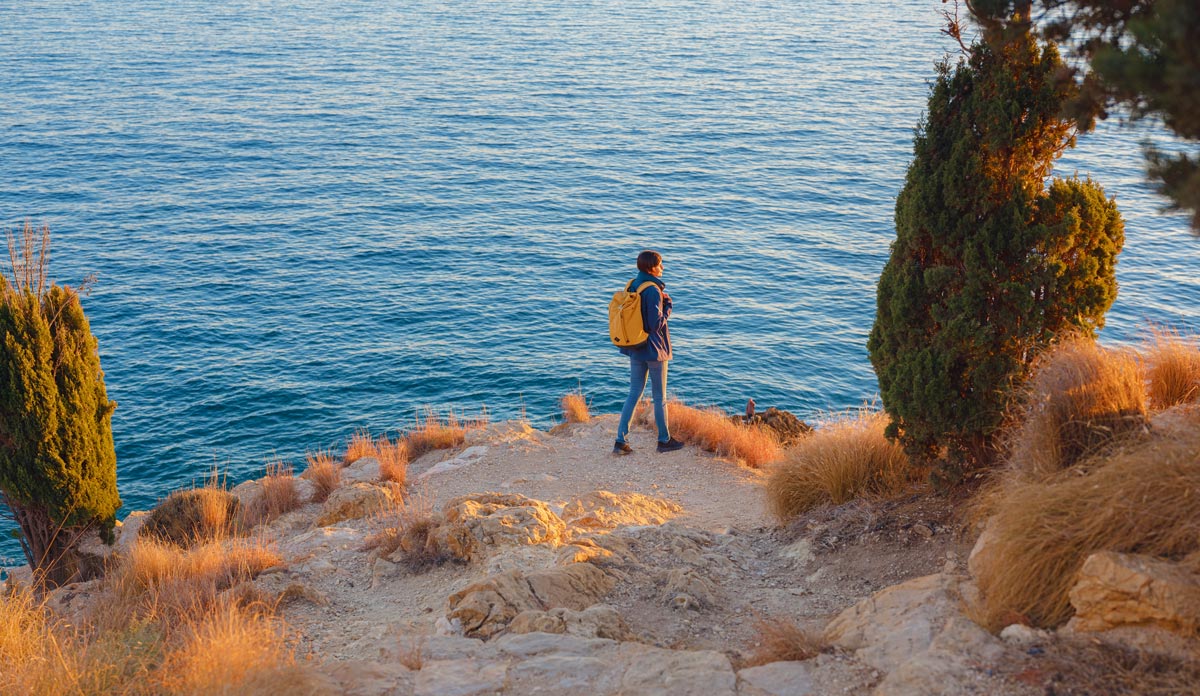
I see it happen often in the afternoon. No sportswear, no watch, no route. Someone closes the door and walks away. Not to get anywhere, but simply to be outside for a while. Walking without a goal. Without a plan, without pace. It looks unremarkable, almost too simple to be called “exercise”.
And yet, something important happens there.
Movement without making it a workout
In many countries, movement is something you schedule. You make time for it, measure it, tie it to goals. In Spain, it works differently. Walking is woven into the day. To the shop, after a meal, stepping outside simply because you can. Not as a performance, but as a natural part of life.
That difference affects how the body responds. As soon as movement stops being an assignment, tension drops away. The body doesn’t have to achieve anything. It is allowed to participate.
I’ve written about this before in another context: movement often works better when it isn’t broken down into targets and schemes, but moves along with how a day naturally unfolds.
Why aimless walking feels calmer
When you walk without a goal, your attention shifts. You look differently. Your breathing settles on its own. Your pace adjusts without conscious control. That isn’t coincidence. The body recognises this kind of movement as safe and predictable.
That’s exactly why regulation happens. Not because you’re doing something “right”, but because you’re not forcing anything. Your internal tempo gets space to restore itself. That’s much harder when every step is being evaluated.
It explains why a short, aimless walk often brings more relaxation than a tightly planned loop.
Walking as a transition, not a task
What stands out in Spain is how walking is used as a transition. Stepping outside after a meal. A short walk before heading home. A brief round through the neighbourhood between work and evening.
These moments mark the end of one phase and the beginning of another. The body understands that. Transitions help release tension without needing explanation.
I’ve written about this before in relation to daily rhythms: fixed moments don’t need fixed times or distances to still provide support.
How to use this yourself, simply
It doesn’t have to be complicated. Choose one or two moments in your day to step outside without a plan. No route, no distance, no app. Walk until you notice your breathing becoming calmer, then turn back.
Let the pace emerge. Sometimes it’s slow, sometimes a little firmer. Both are fine. The only fixed element is the moment itself. Those who do this regularly notice that movement creates less resistance. It doesn’t require discipline, because it isn’t an assignment.
No ambition required
There is nothing to improve about this kind of walking. It works precisely because it isn’t elevated into something bigger. The body doesn’t ask for explanation, only for repetition.
That’s where the strength lies. Not everything needs to be measurable to be effective. Sometimes walking is just walking. And that is enough.
Latest news
Walking without a goal. Simply because it works.

The kitchen in January: simplicity without a dependence on cosiness
January is a month of small conversations. No plans, just people
The Spanish winter trick: living in the warm room
En Ruta! — everything that somehow works (or doesn’t) when you’re on the move in Spain



© 2025 The Sound Of The Costa; All Rights Reserved

